

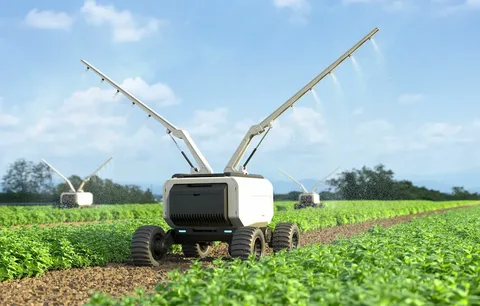
Modern agriculture is undergoing a significant transformation, driven by the integration of advanced technologies. Among these, Artificial Intelligence (AI) and the Internet of Things (IoT) are emerging as key players in improving efficiency, sustainability, and productivity. Integrating AI and IoT in modern smart agriculture is no longer a futuristic concept—it is becoming the backbone of smart farming practices worldwide.
The Role of AI in Agriculture
Artificial Intelligence enables farmers to make data-driven decisions by analyzing large volumes of agricultural data. AI-powered algorithms can predict crop yields, identify potential diseases, and optimize irrigation schedules. With the help of AI, farmers can reduce waste, improve resource allocation, and increase overall efficiency.
IoT: Connecting Farms for Real-Time Insights
The Internet of Things (IoT) brings a new level of connectivity to agriculture. Sensors deployed across fields collect real-time data on soil moisture, temperature, humidity, and crop health. These IoT devices provide farmers with actionable insights, enabling precise interventions that improve crop quality and reduce environmental impact.
Benefits of Integrating AI and IoT in Modern Agriculture
By integrating AI and IoT in modern agriculture, farms can achieve unprecedented levels of automation and accuracy. The combination of predictive AI analytics and IoT data collection enables:
- Precision farming: Targeted fertilization, irrigation, and pest control based on real-time data.
- Resource efficiency: Reduced water usage, energy consumption, and chemical input.
- Early disease detection: AI can identify signs of disease from IoT sensor data, preventing crop loss.
- Enhanced productivity: Optimized planting schedules and crop management improve yield.
Challenges and Future Prospects
Despite the advantages, adopting AI and IoT in agriculture comes with challenges. High initial costs, data security concerns, and the need for technical expertise can slow down implementation. However, as technology becomes more accessible and cost-effective, integrating AI and IoT in modern agriculture is expected to become standard practice, transforming the way we grow food globally.
Conclusion
The fusion of AI and IoT is revolutionizing the agricultural sector. By providing real-time insights, predictive analytics, and automation, these technologies are helping farmers make smarter, more sustainable decisions. As more farms adopt these innovations, integrating AI and IoT in modern agriculture will continue to redefine productivity, efficiency, and sustainability in the farming world.
